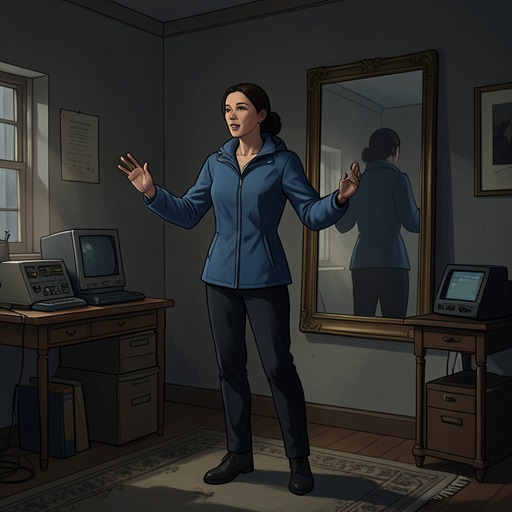
Dance as self-expression and freedom
Loveboat, TaipeiDance as self-expression and freedom is a recurring means by which Ever discovers what she wants and experiences her body as a source of movement, skill, and choice rather than as a subject for other people’s judgment. Its significance develops through several forms of dance: flag performance with Megan, a search for classes in Taipei, and ballet training at Szeto Ballet Studio. Against the expectation that she should pursue medicine, dancing gives Ever not just pleasure but a credible alternative vision of her future.
Movement as a Felt Possibility
During a rehearsal with Megan, Ever sits back-to-back with her and raises a fiberglass flagpole to form the peak of their opening pose. As rhythm begins to organize their movements, their bodies unfold and their black flags travel together through the routine. The choreography is not effortless: Megan apologizes for a wrong-way transition, and the pair collide as their poles scrape. Yet the mistakes belong to the work of practicing together, not to an external judgment of whether Ever should dance.
In the next sequence, Megan’s mirrored movement ruffles Ever’s hair as she turns, swings her flag overhead, and enters a double pirouette. The physical effort is specific—their feet tear at the grass, and the rehearsal leaves Ever with blisters—but it culminates in a feeling of vivid aliveness. Dance registers first as bodily experience: anticipation, rhythm, breathless exertion, and the pleasure of coordinated movement. Ever’s thought about a future dancing instead of walking antiseptic-smelling hospital halls grows directly out of that experience. Megan’s teasing prediction that Broadway will come calling is not a promise or a plan, but it makes the imagined alternative briefly feel possible.
A Practice Wider Than Ballet
Ever’s commitment is not confined to one style. She has trained at the barre for twelve years, and that ballet foundation helped her gain admission to Tisch. In later years she has also explored flag corps and jazz with the dance squad. She describes herself as someone who enjoys different styles and picking up new steps, rather than as a purist. The range matters: dance is not simply a particular discipline imposed on her, but a field of movement she wants to keep exploring.
At Chien Tan, she searches online for studios in Taipei that teach ballet, jazz, modern, and Chinese dance. The search turns up options, but the fees are beyond what she can afford; asking her parents to pay would invite them to redirect her toward the program instead. She calls the summer her farewell to dancing and imagines finding a smaller studio, perhaps farther from the city, like Zeigler’s. The effort to find a class therefore carries the weight of a constrained choice: she is trying to preserve access to the practice while believing that her opportunity may soon end.
Finding a Teacher in Taipei
Szeto Ballet Studio, forty-five minutes from campus on Taipei’s outskirts, offers the opening her search has not yet found. The modest two-story building and its well-loved furnishings contrast with the scale of Ever’s longing; inside, she discovers a studio where girls her age practice at the barre to Tchaikovsky’s “Waltz of the Flowers.” The sight and sound of a familiar ballet class make her heart lift. Dance connects her to a practice she already knows while placing her within a new local community.
Madame Szeto teaches through demonstration and precise correction, speaking Mandarin and then English for Ever. She works on the details of technique: turnout, arm placement, balance, and the lines of energy through the body. Her instruction is demanding but encouraging, with a note of praise for each student. In a second class, she physically adjusts Ever’s arm position and raises her chin, linking a technical correction to an invitation to let her love of dance show. Ever experiences this attention as recognition. Under Madame Szeto’s teaching, a discipline she had valued less than modern and jazz begins to change for her; the possibility of performing Odette in a solo gives her a specific goal and prompts her to work harder on her turns and leaps.
The Body Under Other People’s Judgment
The freedom Ever finds in movement exists alongside efforts to regulate how her body may appear. At a public performance, her mother confronts her while she is wearing a leotard, challenging her choice to appear in it publicly. The scene places the dancing body in a conflict over who may decide what counts as acceptable dress. In another moment, a black chiffon skirt and halter top inspire Ever to imagine movement—leg lifts, turns, and hands around her waist—yet her mother’s remembered disapproval intrudes as she notices the exposed strip of skin between the garments. Her enthusiasm for the outfit and its potential for dance is thus met by an internalized judgment about how others might read her.
A later photography session makes that conflict sharper. Ever decides to pose nude after Sophie has done a back shot; she is frightened and covers herself as she holds the pose. The episode does not make the exposure equivalent to the freedom she finds in dancing. Instead, it shows how a chosen act of self-presentation can become vulnerable to other people’s control. When a photograph of Ever reaches her, Madame Szeto tells her not to return to the studio, treating the image as grounds to exclude her. Ever identifies the photograph as her property and tells Sophie that Sophie had no right to it. The distinction is central: Ever’s agency in choosing to present herself does not authorize someone else to circulate that image or make decisions about her on its basis.
Reclaiming Her Gaze
After the photograph is returned, Ever encounters it again backstage while preparing to perform. She feels the familiar jolt, but this time allows herself to study the image. She recognizes its flattering light, the line of her neck, and her posture. That recognition does not erase the violation: she remains clear that she would rather not have had the photographs passed around. What changes is the extent to which the image can dictate her view of herself. She is no longer mortified simply by seeing her own body.
The change is quieter than the exhilaration of rehearsal, but it belongs to the same larger movement toward self-definition. Dance lets Ever imagine a life she has not been encouraged to choose; Madame Szeto’s teaching lets her develop that desire through work; the photograph conflict clarifies that bodily expression and another person’s claim over an image are not the same. By the time Ever can look at the returned photograph without reducing herself to shame, she has begun to reclaim the perspective from which her body—and her dancing—can be understood.